
A century in the making: Looking back at Leavenworth County Fair’s 100 years
Contributed photo
A 4-H member wins a ribbon in this photo from a show years ago at the Leavenworth County Fair.The sounds of children laughing, the brilliant lights of the Ferris wheel, the bustle of livestock in the barns and the excitement of earning a newly won ribbon have been part of the Leavenworth County Fair for generations.
For 100 years, the fair has celebrated hard work, recognized achievement, and brought families and friends together to create lasting memories.
This year, the Leavenworth County Fair proudly celebrated a century of tradition, community and family fun.
According to a 1976 Tonganoxie Mirror article commemorating the fair’s Golden Anniversary, compiled by then-Fair Secretary Gordon Harman, the fair began in 1926 when Tonganoxie High School vocational agriculture teacher O.M. Williamson recruited his students to participate in a corn show. That year, farmers in southern Leavenworth County had produced a variety of exceptional corn and Williamson wanted the farmers to have a place to display and show off their crops. Williamson can be credited as the founder of the fair, and he served as the first fair board president. Williamson also recruited Walt Neibarger, the editor of The Tonganoxie Mirror, to help start the fair in a room in downtown Tonganoxie. That first fair consisted of an array of corn displayed on the walls. More than 3,000 people came to admire the corn, and Neibarger got the first two fairs qualified with the secretary of the state board of agriculture.
In 1928, the first cattle exhibit took place in the Tonganoxie High School ag room. The Ernest Raymond family of rural Leavenworth showed two, yearling Holstein heifers. By the early 1930s, the annual event was moved to the grounds of the high school and tents were set up to host displays and entertainment. The second fair board president Henry Murr took over in that location in 1936, and his term lasted one year. Murr was a lifetime member of the Kansas Legislature.
The following year, Maurice F. Black took over as the third fair board president. Black had fair experience in Nebraska where he previously lived. He moved his family from Nebraska to a farm south of Tonganoxie in the Reno area. The farmhouse that his family resided in is currently part of Tailgate Ranch. Black moved the fair from tents on the high school grounds to land off Kansas Highway 16 — where the fair is currently held. Black is known as the first fair board president at its current location, and he served until 1946. Black’s entire family was known to be extremely active in the fair. Family members have told stories about Black’s wife, Addie, who was an exceptional baker and won the fair baking competition every year except one year that she competed. The year that she did not win, her daughter-in-law was crowned the winner. Black’s son Wayne also served on the fair board for 20 years during the late 1960s, ’70s and early ’80s. Wayne’s wife, Mildred, was the fair’s public announcer for many years. She could frequently be heard announcing upcoming events, calling out for children who had been separated from their parents, or cars that needed to be moved.
The fourth president, J.C. “Hap” Haigwood served nine years and helped the fair board acquire additional land for the fairgrounds. Haigwood operated a local rock quarry and farm just west of Tonganoxie on 16 Highway. That quarry is currently owned and operated by Leavenworth County. During Haigwood’s tenure, he brought several horses to the fair from the American Royal and helped Lon Pomeroy coordinate and manage the popular horse shows during the fair.
Dale Rawlings of the Tonganoxie Farm Store was the fifth president and his leadership brought in the support of the town’s business community. The farm store was known to have large tents set up at the fairgrounds selling items that could also be found in his store. Rawlings was known to seek out sponsorships for the fair. A placemat from the Kansas State Centennial year fair in 1961 describes the Leavenworth County Fair as the “biggest and finest county fair in the state of Kansas.” The placemat also described the 1960 fair as hosting 35,000 visitors.
Tonganoxie businesses such as Cain’s Drug Store, Seymour and Son Standard Service, and the Tonganoxie Farm Store (selling “the finest grains and seeds”) encouraged visitors to not only visit the fair, but to stop by local businesses as well. During Rawlings leadership, fair attendance drastically increased. Weather played havoc during the early fair days. One year a windstorm blew down several large tents while the fair was in progress. Stories have been told about the early days of showing livestock at the fair. Men would gather around in a circle to form a show ring. Once buildings were constructed, animals were shown inside of a small show arena. Rawlings term ended in 1963.
The next fair board president was Bill Lindel. Lindel was a longtime Leavenworth County Commissioner, and during his term, he worked with county legislators to get legislation passed that enabled the county to levy 1⁄4 mill for buildings and grounds. During that time, the first livestock building was built and each township was represented on the fair board.
The fairgrounds underwent its most significant transformation during the tenure of G.F. “Sandy” Murphy, who became the sixth fair board president in 1971. During his term, a master fair plan was developed by engineers from Kansas State College. Roads, two steel livestock buildings, a judging pavilion, plus swine and sheep facilities were built.
In the 1970s, lighted baseball fields were operated on the fairgrounds by the Tonganoxie Recreation Commission. 4-H clubs and other organizations began meeting at the 4-H building which was a twin to the 4-H building in Lansing.
Enjoying delicious fair food has always been an essential part of the Leavenworth County Fair experience. In the early years, nine food stands lined the southeast side of the fairgrounds, where the Tonganoxie United Methodist Church, Reno Methodist Church, Catholic Church, Christian Church and the Happy Helpers 4-H Club all served hungry fairgoers. The Tonganoxie United Methodist Church became especially well-known for its fried chicken, while the Happy Helpers’ footlong hot dogs were a favorite tradition for many visitors. In later years,
the Happy Helpers and the dairy association relocated their food stands to the north side of the fairgrounds, joining the 4-H Council food stand and the carnival.
Carnival rides have long been a favorite attraction at the Leavenworth County Fair. From soaring to new heights on the Ferris wheel to the excitement of circling motorcycles, generations of children and adults have enjoyed the thrills and excitement of the midway. For more than 40 years, Midland Empire Shows has brought fun, excitement and lasting memories to fairgoers.
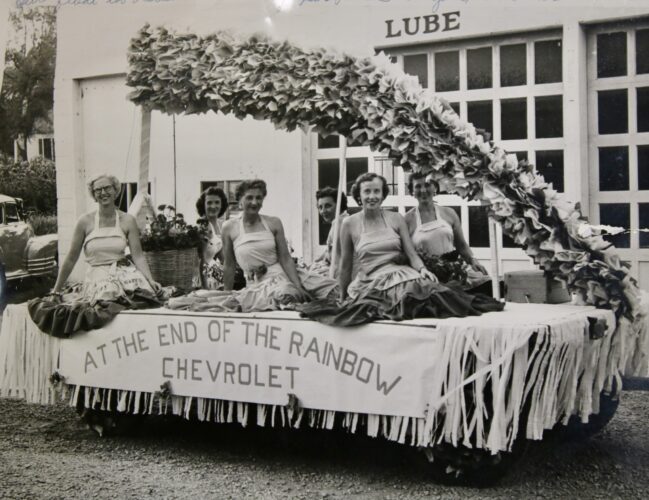
Another longtime tradition of the Leavenworth County Fair is the annual fair parade, which has entertained large crowds for more than 75 years. In its early years, the parade featured floats promoting local businesses, community organizations, political candidates and individuals showcasing their creativity and talents. The event was organized by Bill Seymour Sr. and Bill Stephenson, with Seymour overseeing the parade for its first 35 years. He was succeeded by his son, Bill Seymour Jr., who has continued the family tradition for more than four decades. Today, members of the Seymour family can still be found at the start of the parade, organizing participants, lining up entries, and coordinating the judging of floats and other parade participants.
In May of 2000, a tornado came through Tonganoxie and hit the fairgrounds destroying several buildings that had to be rebuilt. The tornado did not slow down the fair activities, and the fair went on as planned that summer.
Today, families enjoy looking at 4-H and open class exhibits, riding carnival rides, attending the rodeo, participating in the youth tractor pull, watching livestock shows and other fair entertainment; as well as, enjoying a variety of fair foods. Only two food vendors remain from the early days. Happy Helpers 4-H Club whose most sought after item is a taco salad with fresh farm raised tomatoes and the 4-H Council food stand that serves breakfast to early morning visitors and participants; as well, hamburgers and homemade pie for the lunch and evening crowd.
What began as a simple corn show, created to give local farmers an opportunity to exhibit their finest crops, has grown into a celebration of the talents, accomplishments, and traditions of an entire community. For generations, the Leavenworth County Fair has provided opportunities for people of all ages to learn new skills, showcase their achievements, and create lifelong memories. Through the dedication of countless fair board members, community leaders, volunteers, exhibitors and supporters, the fair has become a place where families gather, friendships are strengthened, and traditions are passed from one generation to the next. In 2026, the Leavenworth County Fair proudly celebrated 100 years of growing together — a century of honoring its agricultural roots while looking forward to the future.
Local

Remember When: A Community Review of Tonganoxie for Sept. 16, 2026
Community forum on data center in Tonganoxie; capacity is 750 with only 200 chairs available
Leavenworth County Commission members will be meeting today to listen to residents’ concerns regarding the ...
