
Lawrence transgender woman gets her driver’s license back after the state invalidated it; judge says she’s likely to prevail on her due process claim
Kim Callahan
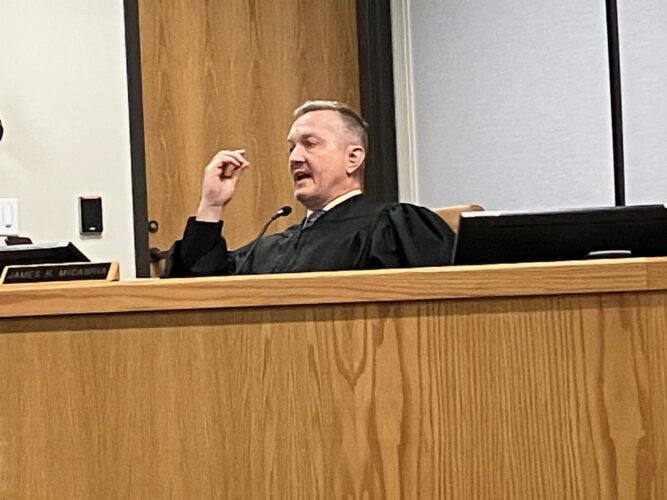
Judge James McCabria is pictured on Thursday, Oct. 30, 2025.A Douglas County judge on Monday granted a Lawrence transgender woman the temporary restoration of her driver’s license after the State of Kansas invalidated it earlier this year under a controversial anti-trans law known as SB 244.
“We’re pleased with the judge’s ruling,” the woman’s attorney, David Brown, told the Journal-World, hopeful that the temporary order boded well for a final outcome in his client’s favor.
“I am optimistic,” he said, characterizing the case as one of undisputed facts. “This is simply a question of what is the law.”
The woman, Jamie Miller, when the case is fully heard later this year, is likely to prevail on her claim that her due process rights were violated, Judge James McCabria wrote in his order granting the injunction.
A substantial likelihood of prevailing is one of several showings that a plaintiff must make to get a temporary injunction. The others are a reasonable probability that she will suffer an irreparable injury without an injunction; the lack of an adequate legal remedy such as damages without an injunction; the threat of injury to her outweighs whatever harm the injunction may cause the other party — here, the state; and the injunction will not be against the public interest.
McCabria found for Miller on all counts, noting that his decision was strictly “about the process, not the subject matter of the underlying dispute.”
The process by which the state invalidated Miller’s driver’s license did not include a meaningful notice of the invalidation nor a meaningful opportunity for Miller to be heard on the matter, he said.
McCabria summarized the Kansas Department of Revenue’s communications with Miller in the wake of SB 244’s passage as a confusing hodgepodge of messages that fell far short of due process. The notices, he said, can be read as “your license will be invalid in two days, you can appeal, no, wait, your license isn’t invalid yet, you can appeal, no, wait, your license has been invalidated because you didn’t do anything to appeal but if you want to appeal, call us.”
No other remedy for the due process violation will suffice, McCabria said, apart from restoring Miller’s right to drive with the license that identifies her as a woman.
Miller, born in 1971, underwent irreversible genital reassignment surgery 13 years ago, according to her lawsuit against the state, and has court orders from Douglas County recognizing that her gender is legally female. Miller, who is also an honorably discharged U.S. military veteran, has had a Kansas driver’s license since 2014 listing her as female. She renewed that license in 2017 and again in 2023 to get the “Real ID” star, both times with a female marker.
But on April 10 of this year, she received a letter from the Kansas Department of Revenue informing her that her license had been invalidated under SB 244, which was enacted in February after the Legislature overrode Gov. Laura Kelly’s veto. The law purports to invalidate driver’s licenses that do not reflect a person’s biological sex at birth.
Miller attempted objections to the law as it applies to her, given a court order that she is legally female, but, as McCabria found, she was never given an opportunity either pre-deprivation of her license, or post-deprivation, to be heard.
It is well-settled law in Kansas, McCabria wrote, that driving privileges are entitled to due process.
Miller’s lawsuit argues that the state law violates her due process rights under the Kansas Constitution, as well as her rights to personal autonomy, privacy, equality under the law and freedom of expression. McCabria’s Monday order only applies to her due process claim and only applies to Miller, not to any other person.
The suit argues that the Department of Revenue has never challenged Miller’s court order declaring her female. It states that the gender marker on her driver’s license has “significant social, legal, and safety implications” for her, and the invalidation of it has caused her isolation from public life and created significant roadblocks to obtaining health care and caring for her disabled daughter.
Among other hardships, she could not sign any document listing her sex or gender as “male” without committing fraud, the suit says. Additionally, she could not legally drive without a valid license, impacting her ability to do basic tasks like going grocery shopping.
“She’s in a weird catch-22,” Brown said of the contradictory state rules: the court order declaring her female and the requirements of SB 244 that would have her be male.
State defendants named in the suit include Attorney General Kris Kobach; Director of Vehicles Deann Williams, of the Kansas Department of Revenue; and Secretary of the Department of Revenue Mark Burghart.
SB 244, which took effect in February, has multiple components that target transgender Kansans, including a provision that invalidates driver’s licenses and birth certificates of people who have changed their gender markers. There’s also a “bathroom bill” component of SB 244, which requires public buildings to designate “multiple-occupancy private spaces” as for either male or female users, based on the person’s sex as assigned at birth, and creates financial penalties for noncompliance.
Two transgender men using the pseudonyms Daniel Doe and Matthew Moe filed a lawsuit earlier this year saying SB 244 violates the Kansas Constitution. That matter, represented by the ACLU, has been consolidated with Miller’s case at the state’s request. McCabria, in Monday’s order, found that plaintiffs’ arguments in the two cases were “so materially similar” that the state should not have to present evidence at two different trials.
The consolidated trial is set to start on Sept. 29.
Brown has been an active supporter of trans rights for the past several years, and Lawrence has been a focal point of that dispute. Three years ago, after the first law known as the “bathroom bill” passed, Brown called it dangerous, cruel and ignorant and told the Journal-World he was determined to do everything in his power to stop it and like-minded legislation.
In May, as the Journal-World reported, Douglas County Judge Carl Folsom III issued a temporary order blocking the State of Kansas from enforcing parts of a law, known as SB 63, that would prevent minors from receiving gender-affirming care, saying that the plaintiffs had shown a reasonable probability that they would suffer irreparable harm if the law stood during the pendency of the lawsuit.
Local

Leavenworth man awaits sentencing on charge related to fatal collision involving motorcycle

Candidate forum for state races Saturday at VFW Post Home
